

- The program was developed with the participation of Harvard Medical School and the Canadian training company Go2Goal
- It has been piloted by the Institute for Trauma Research and Recovery (Canada–Ukraine)
- Participants may receive и 2 professional development certificates
This online course is designed for professionals working with the consequences of traumatic experience in conditions of war and large-scale crisis, including:
- psychologists and psychotherapists
- mental health professionals
- military and crisis psychologists
- specialists in rehabilitation centers and social services
- professionals working in NGOs and humanitarian organizations
About the Methods
Polyvagal Theory
An in-depth understanding of the role of the autonomic nervous system, neuroception, and response states in the formation of safety, mobilization, and shutdown. The course offers practical methods that enable therapists to accurately orient themselves in a client’s state and select appropriate interventions.
Neurobiology of Traumatic Experience
Analysis of the neurobiological mechanisms of trauma, including changes in brain functioning, memory processes, and autonomic nervous system regulation under acute and chronic stress.
Mindfulness
A method that bridges bodily reactions and conscious awareness, expanding the space between trigger and response. Practices focus on cultivating stable presence, self-regulation, and restoring connection with the body.
Self-Mapping Progress Method (SMPM)
An author-developed method for mapping progress and tracking changes in clients’ states, behavioral patterns, and somatic markers. Applicable in individual, group, and interdisciplinary work
Program Uniqueness
Developed in collaboration with Harvard Medical School (Harvard Macy Institute)
80% practical training. The course is designed for professionals who work with people in crisis on a daily basis, rather than focusing on abstract theory
Includes the Training Manual, operational protocols, and tools ready for daily use
Includes the Training Manual, operational protocols, and tools ready for daily use
The opportunity to obtain 2 documents: a Canadian certificate and a state-issued diploma
What You Will Gain from the Course
Tools
Polyvagal state assessment
Identification of ventral vagal, sympathetic, and dorsal vagal response patterns; analysis of trigger responses; neuroception models.
Somatic Regulation Techniques
Grounding practices, breathing techniques, interoceptive exercises, and related body-based methods.
Mindfulness Protocols
Clinically validated approaches aimed at enhancing interoceptive accuracy and autonomic nervous system (ANS) regulation.
Self-Mapping Progress Method (SMPM)
An author-developed progress-mapping method including assessment scales, mapping tools, dynamic markers, and protocols for individual and group work
Complete Set of Working Materials
Workbooks, body maps, and the practical framework “state → symptom → intervention.”
COMPETENCIES
Recognition of Autonomic Nervous System States
You will refine your ability to identify somatic, emotional, and behavioral markers of autonomic states within the framework of the autonomic nervous system and the “window of tolerance” — both in clients and in your own professional self-regulation
State Regulation Using Integrative Methods
You will learn to regulate states of hyperarousal, shutdown, and loss of contact using integrative tools, including situations in which verbal processing is temporarily ineffective — particularly in cases of PTSD, anxiety, depressive, and dissociative manifestations, as well as in selected online practice settings
Strategic Intervention Planning
You will develop the capacity to select interventions based on autonomic state, symptom presentation, and phase of the therapeutic process — rather than adhering to a single-method logic. The polyvagal framework and mindfulness-based approaches will be integrated into daily clinical practice
Monitoring Change and Supporting Progress
SMPM enables the process of change to become visible and structured for both client and clinician. The method supports perceived control, sustained motivation, and integration of therapeutic experience, while reducing baseline distress and promoting long-term stability of outcomes.
A certificate for each participant
Diploma & Certificate
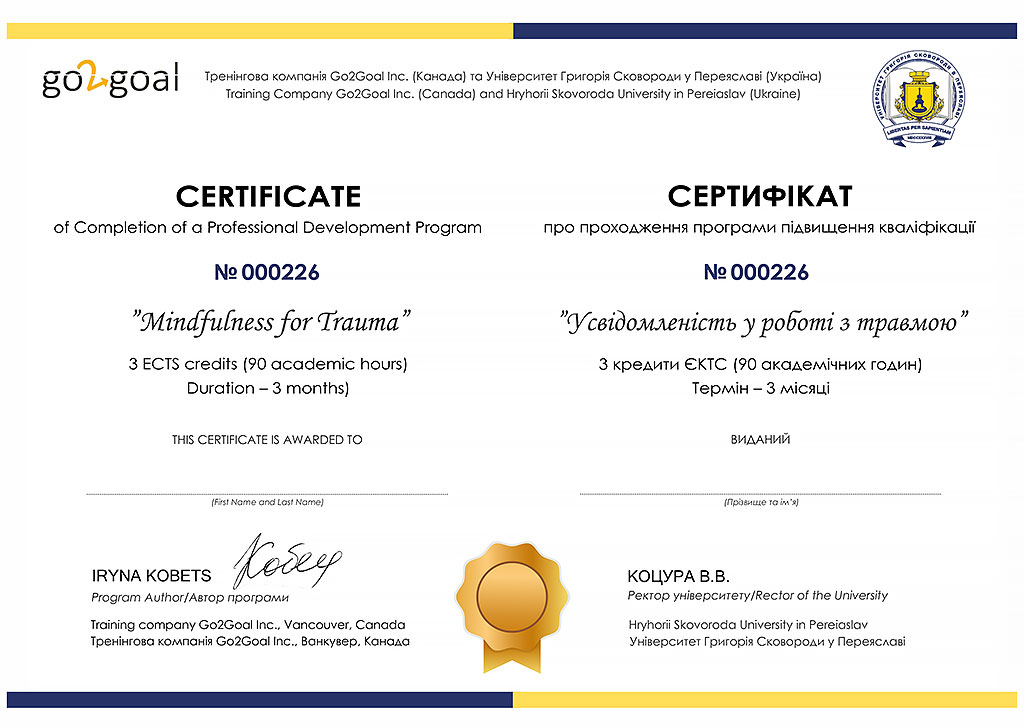
Upon completion of the course, all participants will receive an international certificate from the Canadian training company Go2Goal Inc. If you wish, you can take an additional online exam and receive a state-recognized diploma from Hryhorii Skovoroda University in Pereiaslav.
Course Author
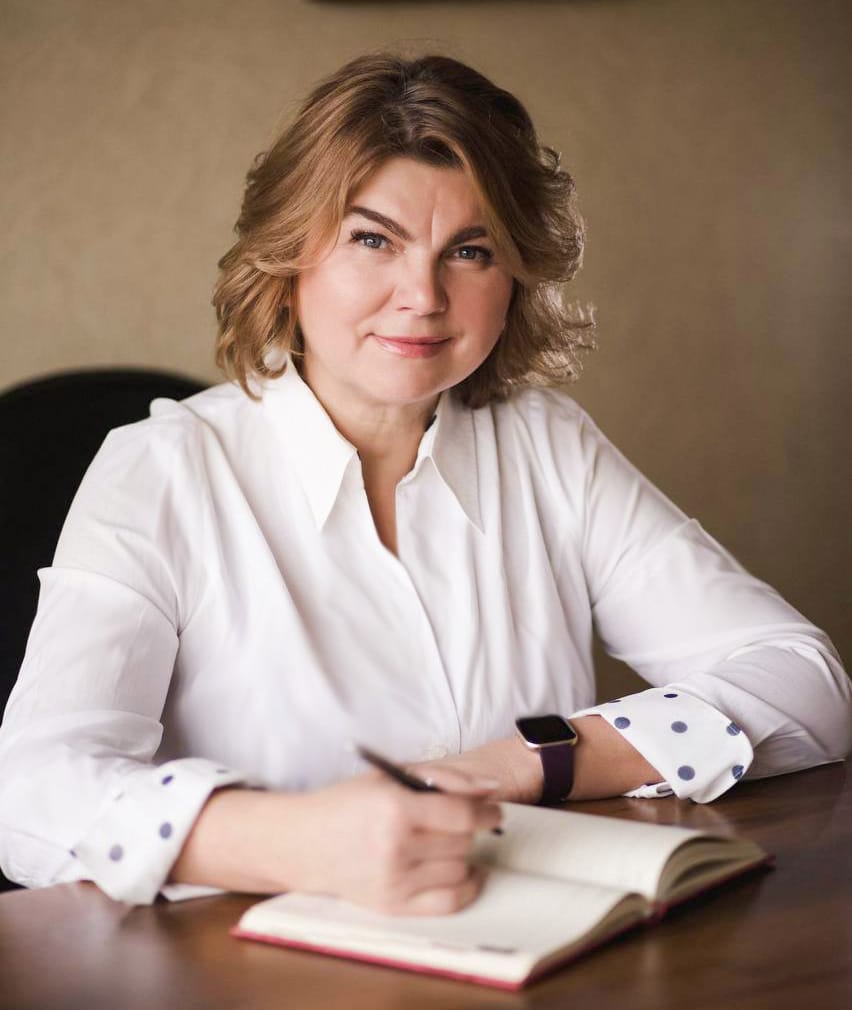
Iryna Kobets Iryna Kobets (PhD, RCC, CCC)
Clinical Consultant · Scientific Trainer · Entrepreneur
Over 20 years of experience in psychological rehabilitation and educational program development. Works with veterans, youth, and families in crisis, combining clinical practice with research and teaching. Co-founder of the Institute for Trauma Research and Recovery.
PhD candidate at Hryhorii Skovoroda University in Pereiaslav and Scholar of the Harvard Macy Institute (Harvard Medical School). Author of the Self-Mapping Progress Method (SMPM).
Member of the World Society of Victimology and Rotary International. Nominated to the Top 100 Women of Ukraine list as an “Influential Woman of Ukraine” in the KIDS industry.
Author of a methodological manual “An Integrative Approach to the Rehabilitation of Veterans with Traumatic Experience” and more than ten educational and rehabilitation programs registered as intellectual property, including in the Library of Congress (USA).
6 Modules + 3 Supervisions
Course Structure курсу
Polyvagal Theory and Mindfulness: Theory and Practice
- The three states of the autonomic nervous system
- Reasons for getting “stuck” in the sympathetic or dorsal state
- Mindfulness practices that help shift into the ventral vagus state
- Neuropsychological effects
- Practical exercises: body scan, breathing, grounding
- “Reactions in Everyday Situations” worksheet with instructions
- Toolbox for self-regulation
- Homework assignments
Somatic Awareness: Reading Bodily Signals
- Theoretical material on polyvagal theory
- Exercises: Map of bodily sensations. “My alarm signal.” Grounding through physical contact.
- Homework
Autonomic Nervous System Dynamics: Activation and Regulation
- The dynamic nature of states
- Interaction with cognitive functions
- Neuroception
- Window of tolerance
- Mechanisms and techniques for transitioning between states:
- Vagus regulation – theory and practice
- Social engagement
- Somatic orientation
- Verbalization of states
- Practical exercises
- State journal
Mindfulness,
як міст між тілом і свідомістю
- How the method works in the context of trauma therapy. Theoretical aspects
- 4 Mindfulness exercises
- Homework assignments
Інтегративний добір інтервенцій у роботі з травмою
- The “Symptom – State – Intervention” Principle
- Exercises to Develop Interoceptive Sensitivity
- Practical Tools
- Homework
Інтеграція підходів та індивідуальна стратегія впровадження
- Consolidating knowledge
- Selecting the tools that best suit your own style and clients
- Creating a personalized Toolbox
- Developing an action plan: support tools, intervention plans tailored to specific clients, and a personalized change plan
Participation Fees
Basic
$ 545
- 6 modules,
- Training Manual,
- 3 supervision sessions,
- international CPD certificate.
Early Birds (until April 25, 2026)
$ 499
- All features of the Basic package
- Additional online examinations
- State-recognized certificate issued by Hryhorii Skovoroda University in Pereiaslav
With State Diploma
$ 554
- All features of the Basic package
- Additional online examinations
- State-recognized certificate issued by Hryhorii Skovoroda University in Pereiaslav
Особливі умови: Для учасників у Канаді можливе покриття через benefits / extended health insurance.
Changes in Clinical Practice After the Course
Alumni Feedback
Marina Doktorovych
Supervisor, Lecturer, Practical Psychologist (MIPO) / Private Practice
The program methodologies proved simple and accessible for clients, and for me they “brought the Polyvagal Theory to life” in practical work.
Somatic exercises, STOP and RAIN techniques, and breathing practices support self-regulation.
The “Symptom – State – Intervention” table significantly saves time and helps structure interventions efficiently.
Clients report improved emotional states, increased awareness, and greater ability to track their own progress. I definitely plan to continue using these tools in my practice.
Lidiia Kolodchuk
Psychologist, MIPO
I work with military personnel, including online. We see positive results already after the first use, and clients find it easy to practice the exercises on their own. The most popular techniques are breathing-based awareness practices — simple, short, and requiring no extra time. Those who continue practicing report feeling calmer, sleeping better, and noticing improvements in their relationships. The written materials are incredibly valuable… they provide a sense of support — everything is at hand, no need to search for anything. The worksheets make the work much easier. There is a rapid positive dynamic. Thanks a lot.
Iryna Smoliar
Trauma Therapist
I enrolled in the course to find new techniques for working with women who have lost their husbands, as well as veterans and their families. At the beginning, there was noticeable resistance in two groups, especially among participants without prior experience in such practices. Over time, the resistance decreased and trust grew. From my experience, about 30% of participants fully integrate the skills into their daily lives, while others return to the practices when needed — yet all report meaningful changes in their state and habitual reactions. I plan to continue using these methods in my projects ‘The Power of Two’ and ‘Hope for Women.’ Thank you for your professionalism and the thoroughly developed materials.
Liudmyla Borysenko
Psychologist, MIPO
In my individual work with military personnel and veterans, outcomes have been positive. I plan to continue using the methods.
Clients respond with interest. After 7–9 sessions, they begin to understand when and how to use specific practices and recall them more consistently in real-life situations.
Overall emotional stability noticeably improves. The techniques resonate with me professionally, and I continue to apply them in practice.
Людмила Борисенко
Психолог, МІПО
В моїй індивідуальній роботі з військовими та ветеранами результати позитивні. Планую продовжувати використовувати методики. Клієнти сприймають з цікавістю. Після 7–9 сесій вони починають розуміти, коли яку практику використовувати, згадують про них в моменті регулярніше. І загальний стан відчутно покращується. Мені всі техніки відгукуються. Апробовую. Дуже вдячна.